
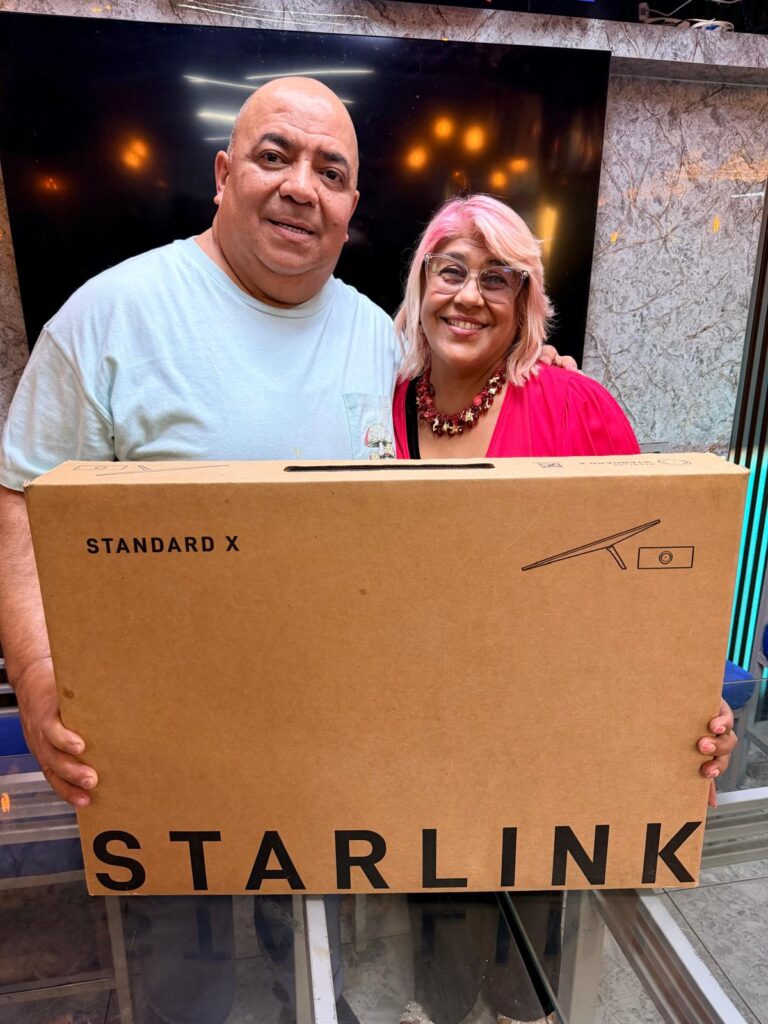
Congratulations to Keison, Belkis and the whole family of Misión Cristiana al Mundo MCM.
A year ago I had the privilege of visiting for the first time the headquarters of the Christian Mission to the World (MCM) in Barquisimeto, Venezuela. Before I knew their programs or listened to their statistics, there was something that immediately caught my attention.
The neighborhood looked different.
In one of the historically most vulnerable and violent areas of the Iribarren municipality, the streets were cleaner. The alleys conveyed a sense of care. The walls were not covered with messages of violence or hopelessness, but with phrases that inspired dignity, hope and responsibility. Words of Mother Teresa of Calcutta, Nelson Mandela and, above all, Jesus’ call to love God and his neighbor.
That was no coincidence.
It was the result of twenty-seven years of constant presence.
A church that decided to stay
Twenty-seven years ago, Keison and Belkis Carrillo began a work in the La Municipal neighborhood, in the then Juan de Villegas parish, today Guerrera Ana Soto, one of the most populated and complex urban areas of the state of Lara.
Many ministries visit vulnerable communities.
They decided to live among this.
Over time, the community began to recognize them as apostles. Beyond an ecclesiastical title, they represent the call of those who help others imagine a different future and work tirelessly to make it possible. They didn’t just plant a church; they sowed a culture of service, hope and transformation.
The Gospel that transforms neighborhoods
In many parts of the world the success of a church is usually measured by the attendance at its meetings.
In MCM I discovered another way to measure the Kingdom of God.
The real impact is observed when a community begins to change.
When violence decreases.
When the children smile again.
When families find support.
When young people discover a greater purpose than gangs.
When the elderly are no longer alone.
When the church ceases to be a building to become a permanent presence in the neighborhood.
That is precisely what Jesus described when he spoke of being “salt and light.”
The Redeeming Economy in action
For several years they have been developing a vision that we call Redemption Economy.
Its principle is simple: God not only wants to save people; he also wants to restore communities, institutions and systems for the common good.
That means that discipleship must produce spiritual, social and economic transformation here and now.
MCM is an extraordinary expression of that vision.
Its Food Bank has served more than 754,000 quality lunches since 2018.
Their ministries reach hospitals, prisons, rural communities, urban neighborhoods, children, women, older adults and entire families.
They train people in trades.
They promote entrepreneurship.
They strengthen homes.
They mobilize volunteers.
They form disciples.
All this without abandoning prayer, biblical teaching or the proclamation of the Gospel, for the MCM all of this is worship!
They do not consider these tasks as separate ministries.
They understand them as a single mission.
The real revival
We often think of revival as large meetings or spiritual manifestations.
But the biblical revival always produced a visible transformation in society.
When a church feeds the hungry, accompanies the prisoner, visits the sick, forms leaders of integrity and returns hope to entire communities, the Kingdom of God becomes visible.
That’s what I’ve seen in MCM.
It’s not just a church that preaches.
It is a church that remains.
A church that serves.
A church that restores.
A model for Venezuela


While Venezuela faces enormous economic and social challenges, we need to multiply models like this.
Lasting solutions will not be born solely from public institutions or international aid.
They will also emerge from thousands of local churches committed to the integral well-being of their communities.
Each congregation can become a center of hope.
Every pastor can be a community builder.
Every believer can become a catering agent.
MCM shows that this is not a theory.
It’s a reality.
Looking forward to the next 27 years
The report shared by Apostle Keison Carrillo on the occasion of the anniversary reflects much more than organizational growth.
It reflects a generation of disciples who today serve in hospitals, schools, prisons, rural communities and cities throughout Venezuela.
That is perhaps the greatest legacy of these first twenty-seven years.
They have not only built a church.
They have raised a movement of men and women convinced that following Jesus means to love with deeds in 40 additional communities.
As the apostle John wrote:
“I was very happy because I have found some of your children walking in the truth.” (2 John 1:4)
After walking through its streets, meeting its leaders and observing the fruit of their work, I can affirm that that verse accurately describes what God has done through Christian Mission to the World.


My prayer is that the next twenty-seven years will multiply this model throughout Venezuela and beyond its borders.
Because when a church lives the Gospel in a comprehensive way, it doesn’t just change lives.
It also redeems entire communities.